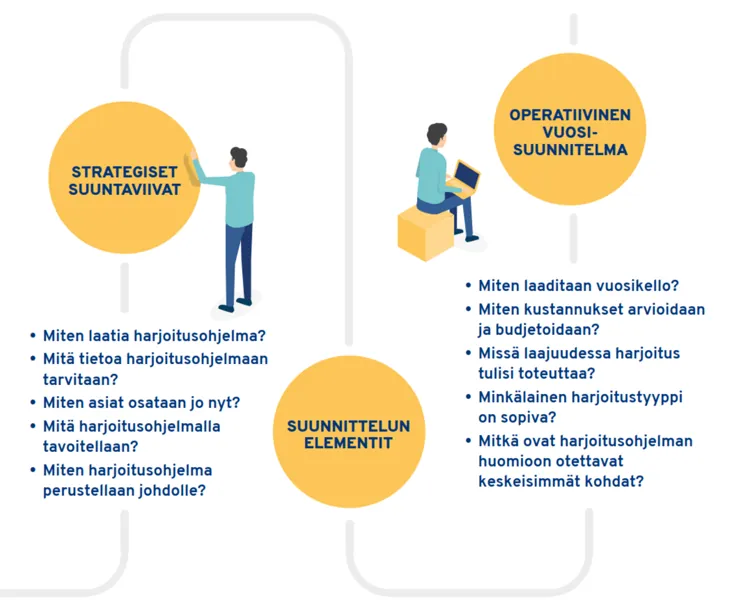
Practical exercises are an effective way of testing the organisation’s operations and identifying areas of development. They help to focus the operational development on essential issues.
This guide is intended to support the strategic planning of exercise activities for managers and specialists responsible for the preparedness, risk management and exercise activities of the organisation or network.
The guide also explains why long-term planning of exercise activities is necessary to ensure the continuity of the organisation’s operations and to increase the level of preparedness to upper management.
The guide also provides grounds for the advance and annual planning of various exercises.
Picture: Three significant subjects of the guide (in Finnish)
The guide was produced as part of the Digital and Population Data Services Agency’s Development Programme for Digital Security in Public Administration (JUDO) in 2020.
An effort is typically made to prepare for disruptions through advance continuity and recovery plans, which take the threats and risks that may cause a disruption into account.
The plans also include ways of
training the necessary staff
planning the organisation’s management models and alternative operating methods suitable for the incident, and
determining the temporary and other facilities required in the event of a disruption.
Typically, the plans take the time required for recovery into account and describe the operating methods that best or as quickly as possible achieve an adequate service level. Testing and validating such a plan requires training exercises.
These exercises are based on threat and risk analyses. Thorough analyses make it easier to understand the situations that the exercises should target. It makes sense to focus the training exercises on threats with significant impacts.
“A chain is only as strong as its weakest link” is also true in practice. In terms of the functioning of society, the activities of both a single public organisation and those of a private company may play a crucial role in remedying the disruption.
While likelihood of unusual conditions can be considered significantly unlikely, plans to counter them should be prepared and tested through exercises.