
Description of the Suomi.fi content cooperation model
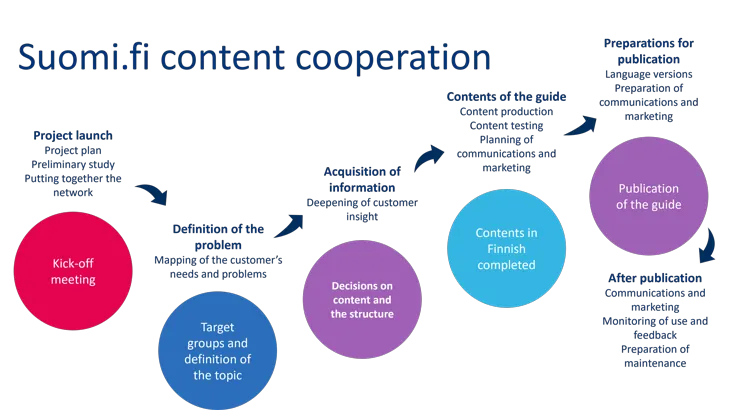
The Suomi.fi content cooperation model is a process for the production of guides by the Suomi.fi editorial team. It takes advantage of the methods of content design, i.e.:
- The customer is prioritised
- Information is collected
- Everything is questioned
- Decisions are based on knowledge
The model consists of five main phases which make it possible to ensure that the guide will be user-centred and functional. After the publication, the content network agrees on the future maintenance of the guide.
The phases of the guide project
At the beginning of each guide project, the editorial team draws up a project plan to enable them to immediately tell the organisations invited to participate in the content network what is coming, what is expected of them in the different phases and when the guide could be published.
You will find information on the roles and responsibilities during the guide project on the How are Suomi.fi guides produced? page.
Next, the editorial team will carry out a preliminary study on the topic to
- gain a well-founded understanding of the topic and its context before engaging the network
- determine which actors at least must be invited to the content network
For example, they will use the following sources in their work:
- Previously conducted customer insight studies
- Statistics, publications, reports and guides, etc. that explain the situation of the target groups
- Current news and phenomena related to the theme
- Benchmarking: how others have addressed the topic
Based on the results of the study, the key public and third sector actors are invited to the content network. In some topics, it may be advisable to also invite private sector actors. If necessary, the network will be supplemented during the project.
This phase ends with the kick-off meeting in which the guide project is introduced and the organisations invited can decide whether or not to participate in the project.
Defining the problem lays the foundation for customer insight. The aim is to provide information that helps to
- decide on the target group(s) of the guide
- define or further specify the topic, if necessary
- determine what needs to be clarified in the Acquisition of information phase.
The definition of the problem is usually carried out as expert interviews and with the help of materials that may have been obtained through the network.
At this stage, it is also possible to supplement the network if necessary.
The selection of the target group or target groups and possible restrictions of the topic are carried out together with the network, so that everyone will have the same understanding of who the guide will be prepared for and what it will be like.
In this phase, customer insight is first deepened on the basis of the selected target group and the possible restriction of the topic. The methods and practices are selected on a project-specific basis and on the basis of what kind of information was available in the preliminary study.
Next, the structure of the guide is designed on the basis of customer insight. In most cases, the structure is presented as a service path – or a content path if the topic of the guide cannot be described as a clear service path.
In this phase, an assessment of the situation of the services related to the guide and their descriptions in the Suomi.fi Finnish Service Catalogue is also started as well as the planning of the launch communications for the guide.
At the end of this phase, the structure and content plan for the guide will be ready and it will guide the production of the contents.
In this phase,
- the contents of the guide are produced in Finnish
- the illustrations for the guide are designed
- the descriptions displayed from the Suomi.fi Finnish Service Catalogue are prepared.
The phase includes several rounds during which the members of the network can comment on the drafts. An important part of content production is customer testing. The method and scope of testing are selected separately for each project.
During this phase, post-publication communications and marketing are also planned together with the network.
At the end of the phase, the contents of the guide are sent for translation.
At this stage, the guide is finalised and made ready for publication, and the launch communication measures for the guide are prepared together with the network.
When everything has been done, the guide is published.
This phase begins with starting communication about the launch of the guide. At the same, the monitoring of the received feedback and the usage data will start.
It is agreed with the network who will continue in the network and participate in the continuous maintenance of the guide and when the first follow-up meeting will be held.
The guide project ends here.
When the project has ended, the guide is transferred to continuous maintenance, which includes at least the following:
- Regular monitoring of feedback received on the guide
- Monitoring and analysing the web analytics about the guide
- Regular communication with the network
- Assessment of the needs to further develop the guide
- Keeping the guide up to date and, if necessary, further development