
Joint custody feature
Using the joint custody feature of Suomi.fi e-Authorizations, acting on behalf of a child is also possible when the guardians have a joint custody agreement for the child.
Background
The guardians of a minor can usually act on behalf of their child in all matters without a specific mandate. The guardians must be registered in the Population Information System. Since autumn 2020, it has been possible to register the division of duties detailed in the joint custody agreement in the Population Information System in a machine-readable format. Now, Suomi.fi e-Authorizations also uses this encoded data when parents act on behalf of their child. However, old agreements with free-form text are not converted according to the new code system.
Until now, acting on behalf of a child may have been impossible if the joint custody agreement also concerned matters other than housing arrangements alone. These limitations are usually recorded in the joint custody agreement as free-form text, which is why they have not been in a machine-readable format. With the new feature, services can now allow users to act on behalf of another party even if a joint custody agreement is in place, as long as the division of duties is defined based on the specific codes.
New features related to joint custody agreements
New joint custody agreements may restrict a parent's right to make decisions or act on behalf of their child only to a category such as social services, health services, early childhood education and care, teaching and education or membership in a religious community. If the service belongs to one of these categories, the guardian can, if permitted by the service, act on behalf of the child regardless of the joint custody agreement. This feature can also be used to apply agreements based on the new template in which the right of access to the child's data has been granted to someone other than the child's guardian.
In this case, parents can use the joint authorisation feature of Suomi.fi e-Authorizations. It allows them to authorise each other or someone else, in which case their joint custody agreement no longer prevents them from using services that have enabled acting on behalf of a child by a mandate.
A service can also set a condition on the rule engine by which acting on behalf of a minor is only possible with a mandate that is granted in Suomi.fi e-Authorizations and confirmed by all guardians. Such situations may include applying for a passport or using banking and insurance services. A mandate granted on behalf of a child may also be granted to a person other than their guardian. In some cases, a service may restrict the use of a mandate on behalf of a minor only to the child's guardian.
Joint custody features with the service rule engine
Rule 021.001.2.2.3
A service may prevent a person from acting on behalf of their minor dependent if there is an order or agreement on the division of the child’s custody related to something other than housing. This is done by selecting rule 021.001.2.2.3. Under the same rule, you can select the GUARDIAN role for the mandate query response to be returned to the service. This role will be returned to the mandate query response if the client is the child's guardian and there is an order or agreement on the division of the child’s custody. In all cases, the guardian automatically has at least the right of access to information. Without this setting, the response to the Authorization query returns ALLOWED or DISALLOWED and the AuthorizationList query returns the ALL role when acting on behalf of a minor dependent person, if the right to use the services exists.
Figure 1 shows the typical rule engine settings of a social welfare and healthcare service to enable acting on behalf of an adult for the management of social welfare and healthcare matters and acting on behalf of a minor dependant also when custody is shared. In this example, acting on behalf of a minor dependant is not restricted by an age limit.
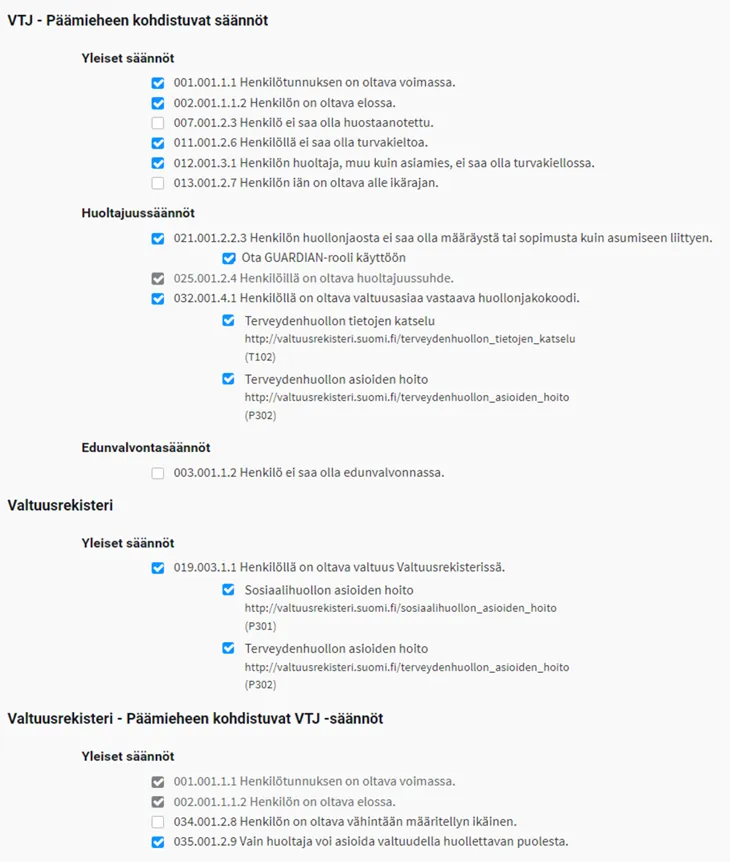
Rule 032.001.4.1
Specific mandate themes have a specific joint custody code attached (see Table 1).
The response to a mandate query does not return the joint custody code, but only the mandate theme to which the joint custody code is attached. A mandate code (mandate theme) based on a joint custody is returned if the other rules produce an allowed response.
We recommend using rule 032.001.4.2 in new deployments instead of rule 032.001.4.1. The new rule enables the implementation of the service‑distribution functionality also for services other than social and health care services. Read more below the table.
Name of the mandate theme | Joint custody code attached to the mandate theme | Description of the joint custody code | Technical identifier (URI) for the mandate theme |
|---|---|---|---|
Managing matters related social welfare services | P301 | Decision‑making right: All social services | http://valtuusrekisteri.suomi.fi/sosiaalihuollon_asioiden_hoito |
Viewing matters related social welfare services | T101 | Right of access to information: All social services | http://valtuusrekisteri.suomi.fi/sosiaalihuollon_tietojen_katselu |
Managing matters related to healthcare | P302 | Decision‑making right: All healthcare services | http://valtuusrekisteri.suomi.fi/terveydenhuollon_asioiden_hoito |
Viewing matters related to healthcare | T102 | Right of access to information: All healthcare services | http://valtuusrekisteri.suomi.fi/terveydenhuollon_tietojen_katselu |
Table 1. Current connections to joint custody codes.
Rule 032.001.4.2
This rule applies to those e‑services that fall under the following use cases: social services, health services, early childhood education and care, teaching and education, or membership in a religious community.
This rule checks whether joint custody decision‑making authority codes or joint custody right‑of‑access‑to‑information codes have been recorded in the Population Information System for the principal’s guardians or persons entitled to receive information. The transaction is allowed if the code is among the selected codes. The response to the authorization query returns the selected joint custody decision‑making authority or right‑of‑access‑to‑information codes.
With this rule, your e‑service can determine more precisely than with the previous Rule 032.001.4.1 whether a guardian specifically has decision‑making authority or a right of access to information. Without adopting this extended response message, an e‑service that uses the joint custody functionality cannot, in all cases, obtain information at this level of detail about the guardian’s decision‑making or information access rights. The need for more detailed information depends on the e‑service and its processes.
Joint custody decision‑making or right‑of‑access‑to‑information code | Description of the code |
|---|---|
P301 | Guardian, decision‑making authority: Social services |
P302 | Guardian, decision‑making authority: Health Services |
P501 | Guardian, decision‑making authority: Early Childhood Education and Care |
P502 | Guardian, decision‑making authority: Education |
P701 | Guardian, decision‑making authority: Religion |
T101 | Person with the Right of Access to Information, Social Services |
T102 | Person with the Right of Access to Information, Health Services |
T201 | Person with the Right of Access to Information, Early Childhood Education and Care |
T202 | Person with the Right of Access to Information, Education |
Table 2. Joint custody decision‑making authority and right‑of‑access‑to‑information codes under the new rule.
Examples of messages
Acting on behalf of a dependant minor
The guardian has the right to act on behalf of the dependant (Authorization query):
[{"result":"ALLOWED","reasons":[],"principal":{"personId":"120508A950F","name":"Kumpulainen Anni Emilia"}}]The guardian has the right to act on behalf of the dependant (AuthorizationList query):
[{"reasons":[],"roles":["ALL"],"principal":{"personId":"120508A950F","name":"Kumpulainen Anni Emilia"}}]The guardian has the right to act on behalf of the dependant ((AuthorizationList query), rule 032.001.4.1 is selected, and the joint custody is agreed on using codes T102 and P301:
[{"reasons":[],"roles":["http://valtuusrekisteri.suomi.fi/terveydenhuollon_tietojen_katselu","http://valtuusrekisteri.suomi.fi/sosiaalihuollon_asioiden_hoito"],"principal":{"personId":"180810A951A","name":"Bergvall Tes Leo Thedor Bertil"}}]The guardian has the right to act on behalf of the dependent (AuthorizationList query), Rule 032.001.4.2 is selected, and joint custody has been agreed with code P301:
[{"reasons": [],"roles": ["P301"],"principal": {"personId": "150814A950C",
"name": "Haark-Magnusson Tes Kiia Priita-Aune"}}]
The guardians have a new, encoded joint custody agreement. One guardian does not have the right to make decisions (P codes), but they have the right of access to information, so when they use the service, the GUARDIAN role is returned if rule 021.001.2.2.3 and the GUARDIAN role are selected:
[{"reasons":[],"roles":["GUARDIAN"],"principal":{"personId":"120508A950F","name":"Kumpulainen Anni Emilia"}}]