
Using external load balancer in the Data Exchange Layer
This article describes how your organisation can enhance the performance and reliability of its security server by using a load balancer. A load balancer is particularly useful during major and unexpected traffic spikes.
External load balancing
In load balancing, the load being processed is shared between the security servers in use so that none of the individual servers is overloaded (see Figure 1). If a server fails and can no longer be used, the load balancer is able to reroute traffic so that the failed server will not be used anymore. In this way, traffic is directed to other servers that are functioning normally.
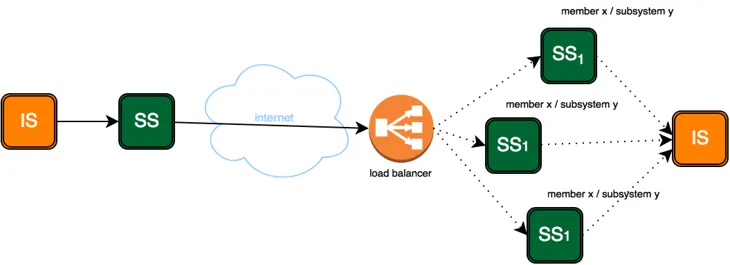
Officially, the Data Exchange Layer has a single security server (master) that the other security servers (nodes, slaves) in the cluster pretend to be. Even if there are several security servers in the cluster, the certificates (authentication and signing certificates) are only required for one security server. In other words, all security servers in the cluster use the same certificates. The security server software of the Data Exchange Layer is able to replicate the certificates and use them correctly with servers in the cluster.
Benefits of a load balancer
With a load balancer, your organisation can enhance the scalability, accessibility and manageability of its services. The existing security server can be cloned if for example it needs a performance boost due to increased usage. In that case, the load is distributed more evenly between security servers, and the number of simultaneous users can be increased and response times reduced. Performance measurements have shown that an external load balancer may more than double the performance of the Data Exchange Layer.
The load balancer also improves system performance during malfunctions. The load balancer disables the failed security server and directs traffic to other security servers that are still active. The reliability of the system can be further improved by doubling the load balancer itself so that there are two of them in working order. In that case, failure of one load balancer does not paralyse the system.
The load balancer can also be used to manage the operations of the security server cluster. For example, when single security server is under maintenance or updated, the load balancer can be notified that the security server in question is not in working and that no traffic may be directed to it. Such situations may occur when you are updating the security server software to a new version and the server in question is disconnected from the cluster for the duration of the update. The server is restored when the software update is complete.
When is load balancing recommended?
The use of an external load balancer should be seriously considered if the number of simultaneous service requests is so high that the capacity of a single security server is insufficient to respond to all of them quickly enough. The use of a load balancer should also be considered if sudden load spikes can be expected. In such cases, the functioning of the service at peak times can be ensured by load balancing (by adding security servers to the cluster).
It is difficult to give the exact number of service requests that would justify the use of a load balancer. This depends on such factors as the capacity and performance of the service provider’s security server (memory, processor, etc.) and the behaviour typical of the service offered through Data Exchange Layer (for example, how large messages it must process and how often). Read more about the technical specifications of the security server.
The estimate is that a load balancer is recommended when there are dozens, hundreds of even thousands of simultaneous users and the service must be able to process hundreds or thousands of messages within a short period of time.
Using a load balancer is also justified if the availability of the service is critical. For example, if it is essential to perform software updates without interruption, a load balancer is required because it allows you to disconnect a single security server from the cluster for maintenance purposes. Other security servers in the cluster allow the service to operate while the update is under way.
Load balancer is the responsibility of the organisation
An organisation can only use load balancing if it has its own load balancer. In other words, the load balancer is not a standard component of the Data Exchange Layer and it is the responsibility of each organisation to purchase, configure and maintain this component. The load balancer must be configured so that the Data Exchange Layer can utilise it.
Useful information
Read more about the instructions and tips for using an external load balancer on following pages:
- X-Road/doc/Manuals/LoadBalancing/ig-xlb_x-road_external_load_balancer_installation_guide.md at develop · nordic-institute/X-Road · GitHubOpens in a new window.
- Material for security server operating and maintenance training (in Finnish)Opens in a new window..
Contact the Data Exchange Layer maintenanceOpens in a new window. for assistance and instructions.